Showing posts with label butterflies. Show all posts

Monday, August 4, 2014

And Then I Smiled.....


     My husband and I made a quick trip home to Tennessee. We visited our family in Nashville and then went on to Sewanee where my comfort zone remains.  After completing a dental visit I raced to the house to ready my cameras and venture out to the lake behind our home. As I proceeded down the trail I saw my husband coming home from a five miles jog, after his early morning meeting. I told him that I was heading to see what was at the lake. He invited me to lunch with his friend, a past colleague, and I thought that I would join them since they weren't going until afternoon. This gave me some time to putter about. But once I got to the lake it was buzzing with raw beauty, the nature and experiences that were part of my life for twelve years and luckily still are! 
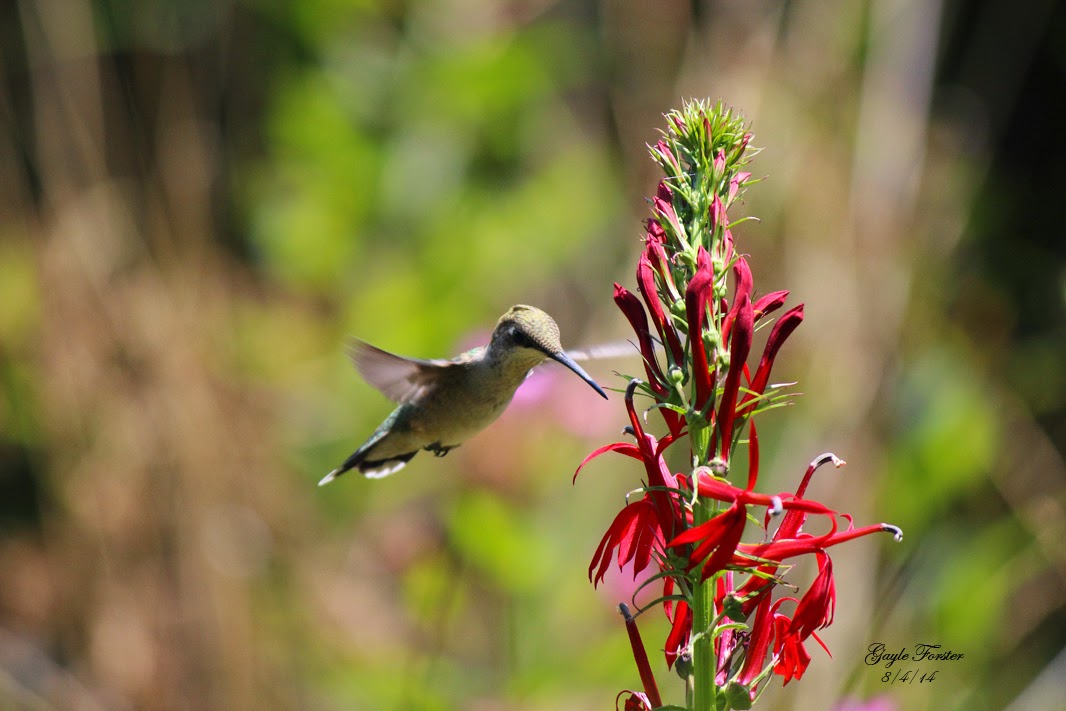
       I ventured all over the 15,000 acres that The University Of The South owns, while in Sewanee full-time over those twelve years. And once I took up the hobby of photography I seemed to never be without my camera. Today I was thrilled to have my cameras with me as I approached the first bridge crossing a small finger of the lake; I was engrossed and in awe over the multitude of dragonflies flitting about as they do this time of year. Finally.... I pulled away from the dragonflies and proceeded to the next bridge. When I started to check out what was stirring, a female hummingbird whizzed past my head and began to feed on the wild flowers,( Lobelia cardinalis) Cardinal Flower that had filled the spillway. Excited, I hurried around the edge of the bridge and down the embankment to get a closer look. I could not wait to get some photos! Several other species of dragonflies were hunting here and even challenging the hummingbirds to leave their territory. They would chase the hummingbirds off but after a short rest and perch on a nearby pine tree they would buzz back through for another sip of nectar!
     The butterflies and hummingbirds fed together on different sides of the plants and I was not able to get a clear photo.  Several times they appeared to be dancing in the air together and I would have loved to have gotten that on video! I had to bog down in the mud up to my ankles and hide in the reeds to get these photos because the growth was so high that I could not photograph above it.  I stood for probably an hour, hardly moving while the hummingbirds, dragonflies and butterflies went from plant to plant.
      I enjoyed my hike and my hour or more of stillness, getting sidetracked so long that I had to pass on my lunch invitation. A few folks strolled pass the bridge, two boys that never noticed me, as they looked for a good fishing spot, a women that simply smiled, an older gentleman asked, “What are you photographing?", as he clutched his binoculars and I whispered, “hummingbirds...nature”!  And then I smiled.


These two contortionist are attempting to mate right?

Excuse me....coming through...(fly by peeping Tom)

Dragonfly...blue dasher I think.


Female hummingbird feeding on Cardinal Flower.


She spotted me and it took her several minutes to return.  I believe there were two hummingbirds feeding in the area.


Wednesday, July 24, 2013

Wild Wonderful West Virginia!

I was eager to hit the trails after a long day of driving to West Virginia. It was not such a difficult drive, it is always just so hard for me to leave family, friends, the forest, lakes and streams of our home in Sewanee and turn it over to the house sitter. This time the animals came along so I have no worries about leaving them. And I have my trail buddy, Miss Carly, in tow. And of course I was heading to be with my husband! It's nice to be torn between wonderful places!
Our outdoor adventures began a bit later than I had hoped, due to a rainy morning. But I have my new water shoes for the muddy spots and the skies had begun to clear off nicely, so we ventured out. My excitement immediately exploded with wildflower sightings and then a plethora of black and yellow swallowtail butterflies appeared in an area covered in one of my father’s favorite wild flowers, Milkweed ( Silkweed - Asclepias syriaca) and Joe-Pye weed (Eupatorium maculatum). Both Milkweed and Joe-Pye weed are tall growing, with a cluster of mauve pink blossoms and they are rugged perennials that the butterflies seem to savor. Like most woodland plants, these wildflowers prefers moist soil to dry and today they were nicely moist at their roots as I stood in the mush to take photos. And I loved every minute of it! Another interesting find for me was a very medium size blossom in soft pink to almost fuchsia. I investigated the plant and noticed fruit growing on it! I was so excited and amazed to see wild raspberries! I am an avid blackberry and dew berry picker but I have never come across wild raspberries. At least that is what I believe these are! I took a chance with what I know about berries and tasted one of these on my second outing for the day. With only a slight bit of trepidation I picked one for a taste. I gently put it to my lip squeezed it a bit then went in for a tiny taste. It was somewhat sweet but still fairly sour. I did a bit of research when I got back to the computer and I believe they were wild raspberries. I haven’t died yet from a poison berry! But I have spent a lifetime in the woods and outdoors. I would never suggest to someone who is not aware of vegetation or berry types to ever try a berry in the wild. And never try berries that the birds don’t eat. That is a sure sign that the berries are not edible! As I always try to do we squeezed in two one hour (or longer) hikes today! The evening was sunny and cooler. I was amazed as the evening went on that our temperature in Beckley dropped considerably. By dinner time it was 66 and on its way down to a possible 55! Wow! I had to pinch myself! Is it summer in West Virginia?


Pipevine Swallowtail

Three Pipevine Swallowtails!


I believe that these are wild raspberries blossoms!


http://uswildflowers.com/detail.php?SName=Rubus%20odoratus

 
Wild Raspberries?


Saturday, April 6, 2013

Mourning Cloak

This was the actual butterfly that landed in front of me.

This butterfly experience kept popping back into my thoughts after a week of intense prayer, time alone with the Holy Spirit, reading the Bible, several other books including, Rick Warren’s book, ”The Purpose Driven Life” (for the second time), and another nearly 3:00 AM awakening with a single vision of a solar eclipse that had happen a few times.  And I don’t have trouble sleeping or rarely ever recall having dreams.  I simply thought, hum…that is weird and then went right back to sleep.  I’ll get back to this striking detail in another post.
I waited nearly a week and it dawned on me that I should look up the name of this butterfly.  It gave me the weirdest feeling when I identified it.  The name of the butterfly is “Mourning Cloak”.   Some websites claim to not have any idea about where the name originated but several claim that it derives its name from the traditional Victorian mourning cloak (worn when someone was in mourning and sometimes draped over the casket of the deceased) due to its dark coloration with light trimmed edges on their wings.  That got my brain going since this butterfly caught my eye as a shadow on the ground and I looked up immediately in shock and astonishment.   First because I had just thought at that very moment about my brother-in-law who had passed away a few years ago in the spring and then shocked because it was early for butterflies! 
As I researched this butterfly more it was simply an amazing butterfly to learn about.  Remember, I mentioned how worn and tattered that it looked in my previous blog post? (With Easter fast approaching it reminded me of Jesus before his crucifixion)  It must have looked tattered because these butterflies are one of the rare butterflies that weather harsh winter cold.  In their adult form, they have a unique way of survival called, “cryo-preservation”.  They find safe places to hide, like cracks in bark of trees, leaf litter and etc.  According to one source of information they have chosen their sheltering place months before (not sure how they know this) and once in their shelter they literally become gradually frozen in their hideout.  They have to find a good shelter to be hidden from birds and squirrels that might find them a tasty winter snack.    
The Mourning Cloak is one of the longest living butterflies.  It is estimated that they live nearly 10-months with 4 or so in this hibernating stage.  It seems sad that they endure the cold winter then die shortly after mating and start the life cycle again.   Some individuals that have studies the Mourning Cloak butterflies indicate that they sometime migrate and that there is a possibility that there could be two generations of Mourning Cloaks during a year with winter hibernation for one group and possible Aestivation which is the summer equivalency to hibernation to avoid the heat and lack of adequate moisture during summer. 
An interesting behavior that was mentioned when I was researching these butterflies is that they will usually seek high objects to perch on and it can make a loud clicking noise when it takes off in flight.  This one stopped me in my tracks by landing on the ground in front of me as if to say look at me.  I suppose that he was simply looking for a sunny spot!
But I cannot help but think that it was a message or way of getting my attention.  Romans 12:2 And be not conformed to this world: but be ye "transformed" (the Greek word for transformed, metamorphosis) by the renewing of our minds.
Romans1:20 “For since the creation of the world His invisible attributes, His eternal power and divine nature, have been clearly seen, been understood through what has been made, so that they are without excuse.”


                       I found this poem that was written by:


                        Unconscious                               U
                  came a beauty to my                         n
               wrist                                                    c
              and stopped my pencil,                         o
         merged its shadow profile with                   n
      my hand's ghost                                            s
   on the page:                                                     c
   Red Spotted Purple or else Mourning               i
Cloak,                                                                o
paired thin-as-paper wings, near black,               u
were edged on the seam side poppy orange,        s
  as were its spots.                                                         C a m e  a  B e a u t y

                                                                        I sat arrested, for its soot-haired
                                                                           body's worm
                                                                           shone in the sun.
                                                                           It bent its tongue long as
                                                                             a leg
                                                                             black on my skin
                                                                               and clung without my
                                                                               feeling,
                                                                                 while its tomb-stained
                                                                                    duplicate parts of
                                                                                      a window opened.
                                                                                        And then I
                                                                                           moved.


Tuesday, May 22, 2012

Our Great Pollinators

The amount of pollen that this bee had collected was amazing!  He was sprinkled with pollen everywhere!

A honey bee in utter delight of the reb bud blossoms (like me!) and getting an early start on the season back in March.
Our Salvia seems to be a great attraction for the bumble bees because they visit it often!


This bumble bee is either chilled out or totally pooped out!  I got so tickled at the way it was resting on this leaf.


There are many different pollinators and they work differently since they are not all designed the same. Each type of pollinator feeds on different plants and therefore pollinate different plants in different ways. The most common pollinators are bees, butterflies, birds, and moths. But that's not all, there are more! Other pollinators include flies, beetles, bats, occasionally the wind and man sometimes either by accident and sometimes the deliberate processes that we use to pollinate in order to make better and stronger plants occurs.
To be pollinated, pollen has to be transfered from a stamen to the stigma. When pollen from a plant's stamen is transferred to that same plant's stigma, it is called self-pollination. When pollen from a plant's stamen is transferred to a different plant's stigma, it is called cross-pollination. When cross-pollination occurs it produces stronger plants. The plants have to be of the same species or family in order for cross-pollination to occur. For example, only pollen from a rose can pollinate another rose. Pollen from a daisy or an pear tree would not work on a rose.  It is interesting to watch bees, butterflies and etc. helping this process happen!


This bee had evidently been busy!  And he continued to collect pollen from this thistle flower.


This is an Eastern Tiger Swallowtail (Papillo glaucus) helping with the pollination process of the wild azalea. Native azaleas are deciduous shrubs that are in the rhododendron family. They are fairly common where I live as well as an abundance of the mountain Laurel however; I have not noticed the common rhododendron growning abundantly and wild in our forest.