Showing posts with label bees. Show all posts
Friday, April 18, 2014
Relaxing In Nashville
It was a relaxing day in Nashville with our family and our son's dog. I enjoyed the bees buzzing about and the flowers that are in bloom in my in-laws back yard. I have been ready for the flowers to get fully in bloom and the insects to begin their work, so everywhere that I go I am in search of something to photograph. And there is lots to see even in your back yard!
Labels:
back yard,
bees,
flowers,
insects,
photograph
Tuesday, July 16, 2013
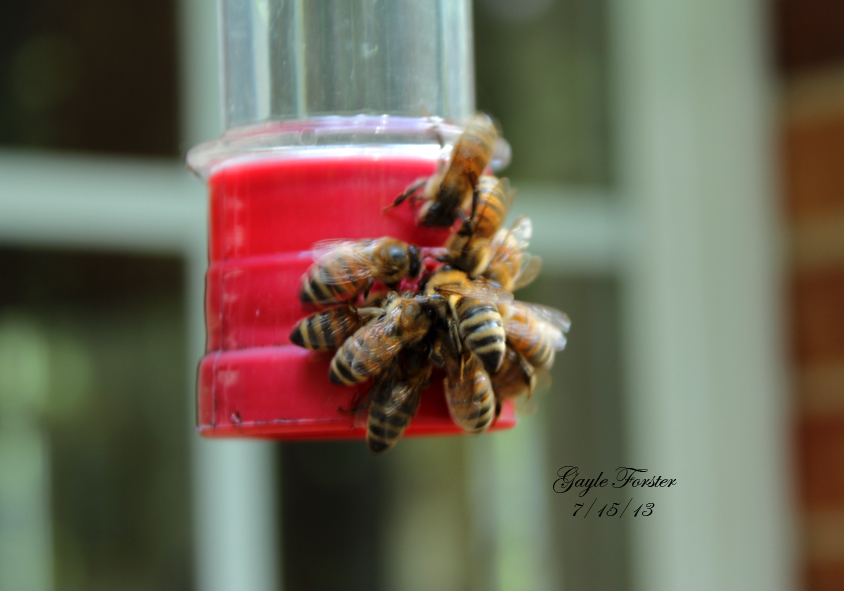
Battling The Bees For Sugar Water
https://www.youtube.com/watch?v=E9e46_9NGOY <~~~~~~VIDEOS OF A HUMMINGBIRD ~~~~~~~~~~> BEES https://www.youtube.com/watch?v=9AEtYhmCSfk
The hummingbirds have been feeding like crazy since I had to buy new little hummingbird feeders. The squirrels had chewed the little nipples off almost all of my feeders. Now after nearly two weeks the bees and yellow jackets have found the feeders too. I went out to see what I could do to help ward off these greedy little buggers. I am happy to report that I did NOT get stung. They all seemed happy to see me coming! They were feverishly crowding to each one of the feeders as though they had discovered the best thing ever..... SUGAR! I think that after watching a CNN segment last year on the effects of sugar and the human brain I have to ask...."I wonder what this is doing to the brains of hummingbirds, bees and yellow jackets???" They seem ADDICTED! The segment talked about how in some people's brains sugar can elicit cravings and trigger responses that are very similar to those caused by cocaine and other addictive drugs. I wonder if by offering sugar water, I am causing an epidemic of dependent creatures of nature looking to me for a FIX!?!
Tuesday, May 22, 2012
Our Great Pollinators
![]() |
| The amount of pollen that this bee had collected was amazing! He was sprinkled with pollen everywhere! |
| A honey bee in utter delight of the reb bud blossoms (like me!) and getting an early start on the season back in March. |
![]() |
| Our Salvia seems to be a great attraction for the bumble bees because they visit it often! |
![]() |
| This bumble bee is either chilled out or totally pooped out! I got so tickled at the way it was resting on this leaf. |
To be pollinated, pollen has to be transfered from a stamen to the stigma. When pollen from a plant's stamen is transferred to that same plant's stigma, it is called self-pollination. When pollen from a plant's stamen is transferred to a different plant's stigma, it is called cross-pollination. When cross-pollination occurs it produces stronger plants. The plants have to be of the same species or family in order for cross-pollination to occur. For example, only pollen from a rose can pollinate another rose. Pollen from a daisy or an pear tree would not work on a rose. It is interesting to watch bees, butterflies and etc. helping this process happen!
![]() |
| This bee had evidently been busy! And he continued to collect pollen from this thistle flower. |
| This is an Eastern Tiger Swallowtail (Papillo glaucus) helping with the pollination process of the wild azalea. Native azaleas are deciduous shrubs that are in the rhododendron family. They are fairly common where I live as well as an abundance of the mountain Laurel however; I have not noticed the common rhododendron growning abundantly and wild in our forest. |
Labels:
bees,
butterflies,
flowers,
Nature,
photos,
pollinators
Subscribe to:
Posts (Atom)